

 Download App


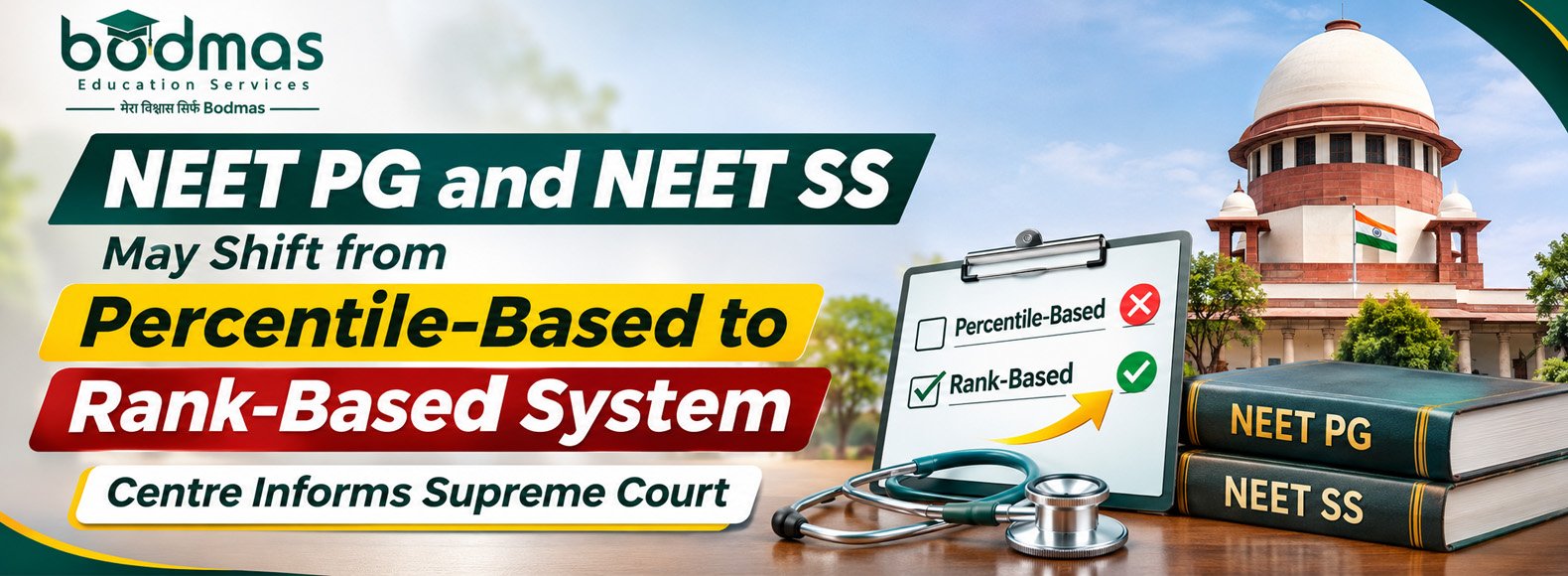
The Centre has informed the Supreme Court that the National Medical Commission (NMC) has given in-principle approval to replace the existing percentile-based qualifying system with a rank-based merit system for NEET PG and NEET SS. The proposed change aims to improve the admission process, reduce counselling delays and maintain standards in postgraduate medical education.
NEET PG Admission System May Undergo Major Changes
The medical admission process in India may see a major change in the coming academic sessions. The Central Government has informed the Supreme Court that the National Medical Commission (NMC) is planning to introduce a rank-based merit system for the National Eligibility-cum-Entrance Test for Postgraduate (NEET PG) and NEET Super Speciality (NEET SS).
Rank-based merit system for NEET PG
Currently, candidates are evaluated under a percentile-based qualifying system. However, a 12-member expert committee formed by the Central Government has recommended replacing this system with a rank-based approach.
The NMC has given in-principle approval to the proposal. A draft regulation is expected to be released shortly for comments and suggestions from stakeholders before the final rules are introduced.
It is important to note that the proposed change currently concerns NEET PG and NEET SS, not NEET UG.
Why Is the Government Planning to Change the NEET PG System?
The proposed reform comes after controversy over the reduction of qualifying cut-off percentiles in NEET PG 2025.
In January 2026, the qualifying cut-off for NEET PG counselling was significantly reduced to fill vacant postgraduate medical seats.
Under the revised criteria:
General and EWS candidates: The qualifying score was reduced from 276 to 103 out of 800.
SC, ST and OBC candidates: The qualifying score was reduced to minus 40.
The decision raised concerns about the quality of postgraduate medical education. The Supreme Court also questioned whether such a significant reduction in qualifying standards could affect the quality of medical professionals.
Following these concerns, the court asked the Central Government to review the existing NEET admission system and suggest practical reforms.
The government subsequently formed a 12-member expert committee to examine the admission process, identify problems and recommend improvements.
What Is the Difference Between Percentile-Based and Rank-Based Systems?
The existing percentile-based system measures a candidate's performance in comparison with other candidates who appeared in the examination.
For example, a candidate scoring at the 90th percentile has performed better than approximately 90% of the candidates who appeared for the examination.
Under a rank-based system, candidates are placed in order according to their examination performance. Their position in the merit list determines their rank.
In simple terms:
Percentile-based system: Shows how a candidate performed compared with other candidates.
Rank-based system: Shows the candidate's position in the overall merit list.
The proposed system is expected to give greater importance to merit-based ranking during postgraduate medical admissions.
However, the final admission rules, including eligibility requirements and the treatment of qualifying scores, will depend on the regulations issued by the NMC.
Expert Committee Suggests Measures to Reduce Vacant Medical Seats
Apart from recommending a rank-based admission system, the expert committee has proposed several measures to address the growing number of vacant postgraduate medical seats.
The major recommendations include:
1. Reduction in Fees for Non-Clinical Courses
The committee has suggested that state fee fixation committees consider separate fee structures for clinical and non-clinical postgraduate medical courses.
Fees for non-clinical branches could be reduced to encourage more candidates to accept these seats.
2. Exemption from Service Bonds
Candidates taking admission to pre-clinical and para-clinical courses may receive exemption from mandatory service bond requirements.
The recommendation aims to encourage students to choose these branches and reduce the number of vacant seats.
3. Additional Counselling Rounds
The committee has supported additional counselling rounds to ensure that postgraduate medical seats do not remain vacant.
However, it has also pointed out that conducting too many counselling rounds can increase delays in the admission process.
4. Biometric Verification to Prevent Seat Blocking
The committee has suggested that examination authorities, including the National Board of Examinations in Medical Sciences (NBEMS) and the National Testing Agency (NTA), explore KYC and biometric verification systems.
This could help prevent candidates from appearing in examinations simply to block medical seats.
5. Review of Vacant Dental and Nursing Seats
The committee has also recommended reviewing dental and nursing seats that remain vacant for two to three consecutive years.
It has suggested improving employment opportunities and considering fee reductions to encourage students to take admission in these courses.
NEET PG Counselling Process May Also Become Faster
The expert committee has also highlighted delays in medical counselling, which have repeatedly affected the commencement of academic sessions.
To address these problems, the Medical Counselling Committee (MCC) has introduced several changes in the 2026-27 counselling process.
Some important changes include:
Freeze and Float Options: Candidates can choose whether to retain their allotted seats or participate in the upgradation process.
Online Seat Relieving: Candidates receiving an upgraded seat can complete the process of leaving their previous seat online.
Single Fee Payment: Candidates are required to pay fees only once at the institution where they finally take admission.
Online Document Verification: Candidates can upload their documents online for verification by the concerned institutions.
Improved Seat Matrix: The NMC has been integrated into the MCC counselling portal to improve the accuracy of medical seat information and prevent duplication.
The committee has also recommended that MCC prepare a fixed counselling schedule for every academic year and ensure that verified seat information is available before counselling begins.
What Does the Proposed Rank-Based System Mean for NEET PG Aspirants?
The proposed change could bring important developments for doctors preparing for postgraduate medical admissions.
A rank-based merit system may make the admission process more focused on candidates' positions in the merit list. It could also help reduce complications associated with changes in qualifying percentile cut-offs during counselling.
However, candidates should understand that the proposal is still under consideration. The final regulations have not yet been issued.
Aspirants should continue preparing according to the existing NEET PG examination pattern and follow official announcements from the NMC and NBEMS for further updates.
Supreme Court hearing on NEET PG cut-off
What Happens Next?
The National Medical Commission has given in-principle approval to the proposed shift from a percentile-based qualifying system to a rank-based merit system.
The draft regulations are expected to be released for stakeholder consultation. The final implementation will depend on the approval and notification of the new regulations.
The Supreme Court has also granted the petitioners time to submit their responses to the expert committee's report and has adjourned the matter.
Conclusion
The proposed shift from a percentile-based to a rank-based merit system could become an important reform in India's postgraduate medical admission process.
Along with changes in the merit system, recommendations such as reducing fees for non-clinical courses, providing service bond exemptions and improving counselling procedures aim to address vacant medical seats and admission delays.
For NEET PG and NEET SS aspirants, the final NMC regulations will be important. Candidates should wait for the official notification before making any assumptions about future admission and counselling procedures.
Powered by Froala Editor