

 Download App


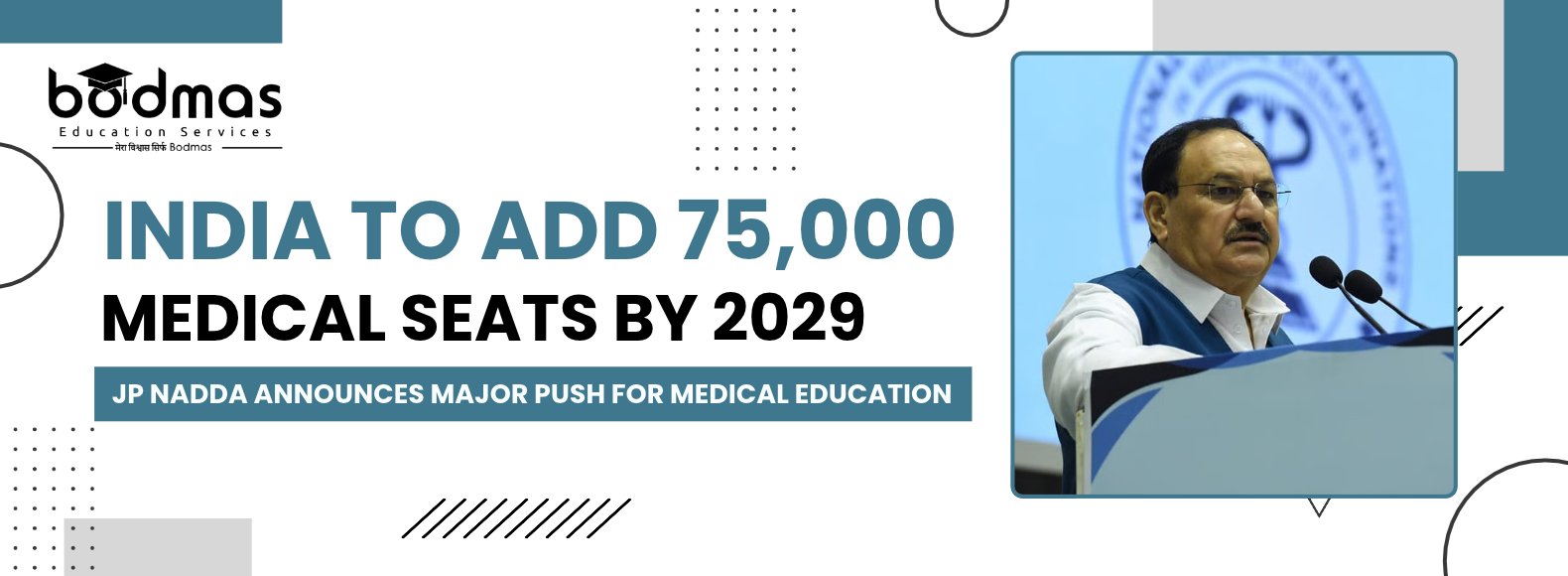
Union Health Minister JP Nadda has announced plans to add 75,000 undergraduate and postgraduate medical seats in India by 2029. The announcement is expected to bring more opportunities for students seeking admission to MBBS and postgraduate medical courses.
India is planning to expand its medical education system by adding 75,000 undergraduate (UG) and postgraduate (PG) medical seats by 2029. Union Health Minister Jagat Prakash Nadda shared this information while speaking at the HealthWealth Summit 2026.
According to the report published by India Today on October 29, 2026, the government has already added 45,000 medical seats over the past two years. The initiative aims to provide more opportunities for aspiring doctors and strengthen medical education across the country.
JP Nadda on Medical Education Expansion
During his address, JP Nadda highlighted the growth of medical colleges and medical seats in India. He said that the country is working towards the target of adding 75,000 more UG and PG medical seats by 2029, as announced by Prime Minister Narendra Modi.
The Health Minister also explained that the government's focus is not limited to increasing the number of seats. It also aims to improve the quality of medical education and strengthen healthcare infrastructure.
Here are the major points highlighted by JP Nadda:
75,000 additional medical seats: The government aims to add 75,000 UG and PG seats by 2029.
45,000 seats already added: According to Nadda, 45,000 medical seats have been added over the last two years.
More medical colleges: India now has 863 medical colleges, compared with 387 earlier.
Growth in MBBS seats: Undergraduate medical seats have increased from around 51,000 to 1.43 lakh.
Growth in PG seats: Postgraduate medical seats have increased from approximately 31,000 to 86,000.
These figures reflect the expansion of India's medical education system and the government's plans to create more opportunities for future doctors.
₹15,000 Crore Allocated for Postgraduate Medical Seats
JP Nadda also highlighted the government's financial commitment to postgraduate medical education.
According to the India Today report, the Centre has allocated ₹15,000 crore to support the creation of 10,000 postgraduate medical seats. The proposed funding works out to ₹1.5 crore per seat.
This investment is expected to support the development of medical education infrastructure and create more opportunities for doctors who want to pursue specialisation after completing their MBBS.
Postgraduate medical education is important because India needs trained specialists across different medical fields, including medicine, surgery, paediatrics, obstetrics and gynaecology, and other clinical specialities.
India Now Has 23 AIIMS and 863 Medical Colleges
Another important point highlighted by the Health Minister was the expansion of medical institutions across India.
The country now has 23 All India Institutes of Medical Sciences (AIIMS), compared with just one earlier. The number of medical colleges has also increased from 387 to 863.
The expansion of medical institutions can help improve access to medical education and healthcare services in different parts of the country.
However, the availability of seats alone is not enough. Medical colleges also need qualified faculty members, well-equipped laboratories, teaching hospitals, clinical training facilities and other essential resources to maintain educational standards.
What Does This Mean for NEET Aspirants?
The proposed addition of medical seats could be encouraging news for students preparing for the National Eligibility cum Entrance Test (NEET-UG) and NEET-PG.
More undergraduate seats could create additional opportunities for students seeking MBBS admission. Similarly, an increase in postgraduate seats could benefit MBBS graduates who want to pursue MD, MS and other postgraduate medical programmes.
However, students should remember that the announcement does not guarantee admission to a medical college. Admission will continue to depend on the applicable entrance examination, merit, reservation rules, counselling procedures, seat availability and eligibility requirements.
Students should also check the official seat matrix and counselling notifications before making admission decisions.
Will More Medical Seats Make Medical Education More Accessible?
The expansion of medical seats is an important step towards increasing the availability of trained doctors in India. More seats could help students access medical education without having to depend on a limited number of institutions.
At the same time, the overall cost of medical education, the availability of government college seats, tuition fees in private medical colleges and the distribution of doctors across rural and urban areas remain important issues.
The impact of this initiative will depend on how effectively the new seats are created and how well the institutions maintain educational quality.
Conclusion
JP Nadda's announcement highlights the government's plan to expand India's medical education system. With a target of adding 75,000 undergraduate and postgraduate medical seats by 2029, the initiative could create more opportunities for future doctors.
For NEET aspirants, the development is worth following. Students should continue preparing for entrance examinations, monitor official admission updates and carefully compare colleges, courses and fees before participating in counselling.
The planned expansion will be significant for medical education if it combines more seats with quality teaching, practical clinical training and affordable access to medical courses.
Powered by Froala Editor