
 Download App


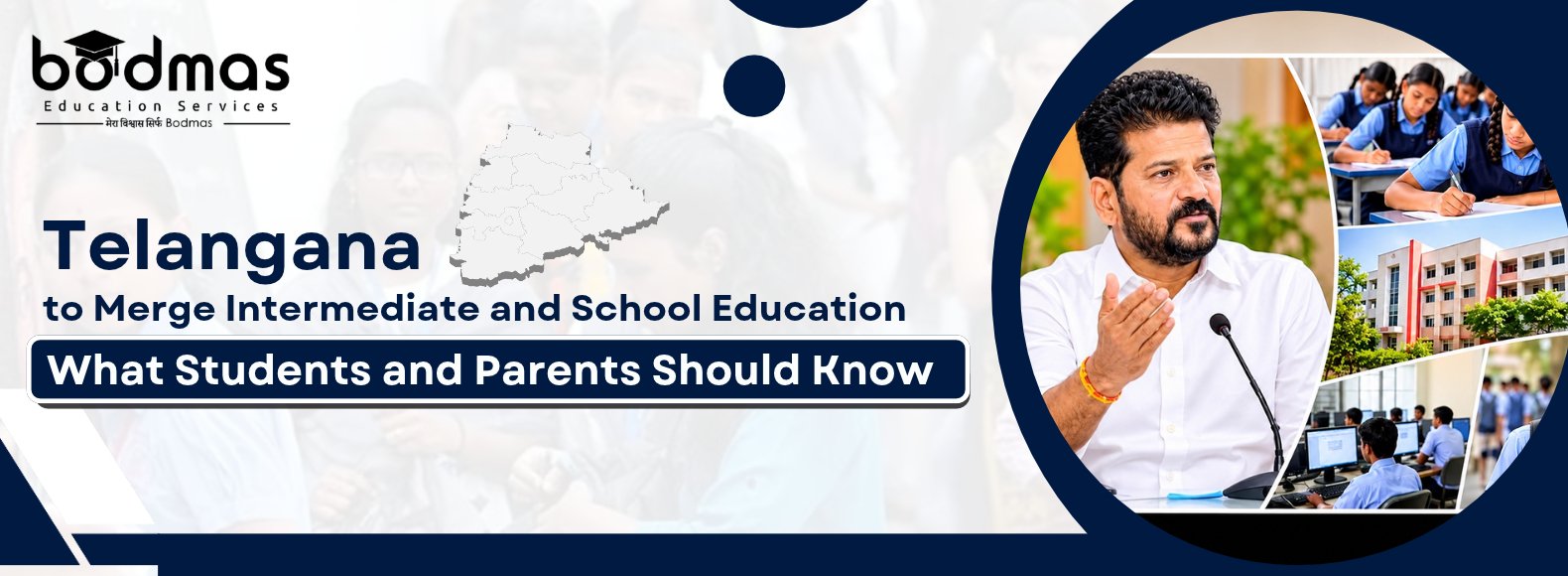
The Telangana government has announced plans to bring Intermediate education under the School Education Department. The proposed reform aims to create a unified education system from the early school years to Class 12, reducing the gap between secondary and higher secondary education.
Under the proposed system, students will be able to continue their education within an integrated school structure instead of moving to separate junior colleges after completing Class 10. The government believes this change could improve student retention, provide better academic support and make the education system more organised.
The reform is expected to begin from the academic year 2027-28, although several administrative and legal changes are still required before its full implementation.
Why Does Telangana Want to Merge Intermediate and School Education?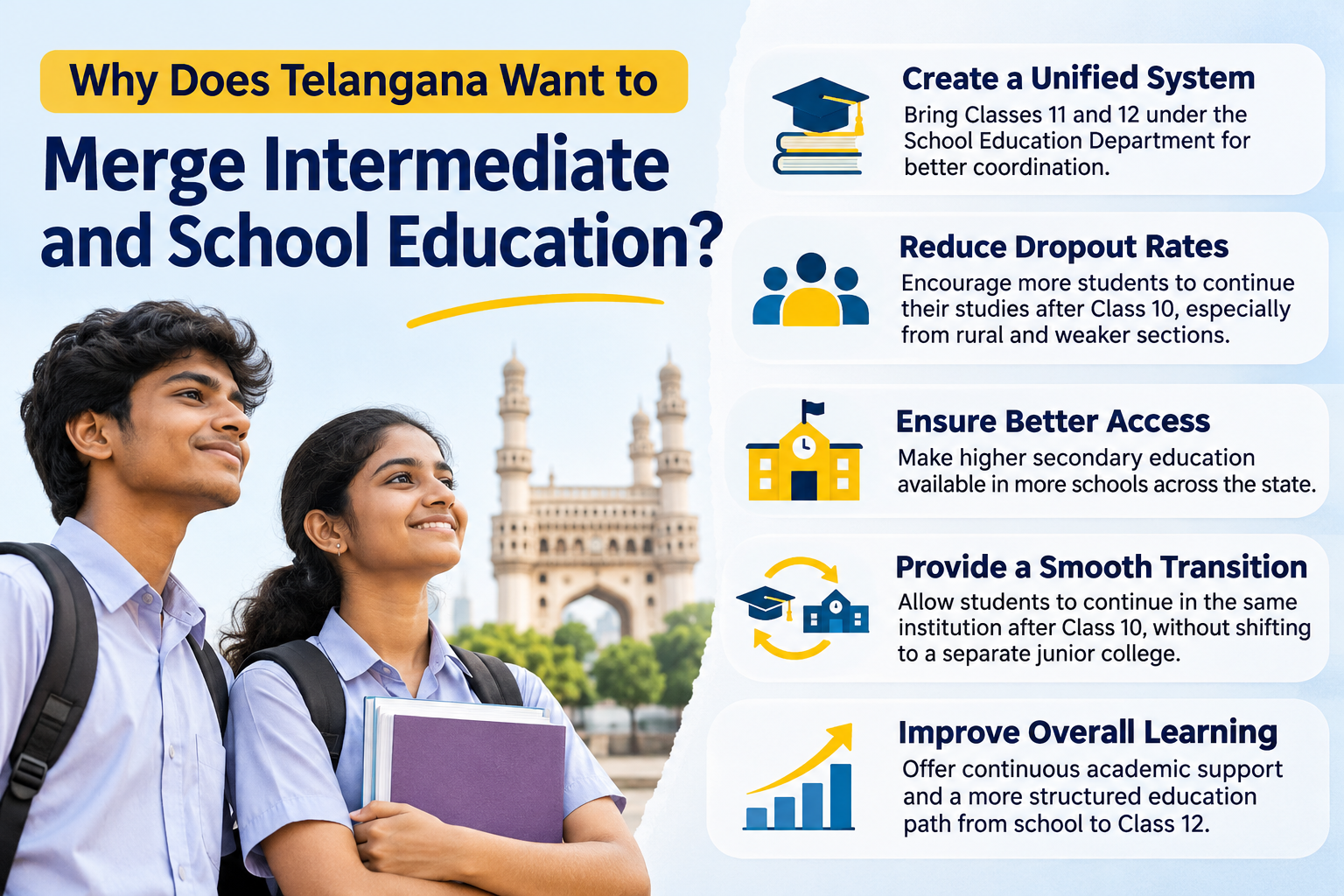
Currently, Telangana has two separate systems for school and Intermediate education.
Students study up to Class 10 in schools under the School Education Department. After completing their SSC examinations, they generally move to junior colleges for Intermediate First Year and Second Year, equivalent to Classes 11 and 12.
The government believes that this transition creates challenges for students, particularly those from rural areas and economically weaker families.
According to government officials, a considerable number of students discontinue their education after Class 10 instead of enrolling in Intermediate courses. The distance between schools and junior colleges, financial difficulties and limited access to educational institutions are among the reasons behind this problem.
By bringing Classes 11 and 12 into the school education system, the government wants to provide students with a continuous learning environment from the beginning of their education until Class 12.
What Will Change Under the New Education System?
Under the proposed structure, Telangana plans to reorganise its education system into three major stages:
Primary Education: Kindergarten to Class 4
Secondary Education: Classes 5 to 8
Senior Secondary Education: Classes 9 to 12
The proposed structure will bring students from Classes 9 to 12 under a common senior secondary education framework.
Schools with the necessary infrastructure may introduce Classes 11 and 12, while existing junior colleges may also be upgraded to offer additional school-level classes.
The objective is to develop integrated educational institutions where students can complete their schooling and senior secondary education without changing institutions after Class 10.
Will Telangana Have a New Education Board?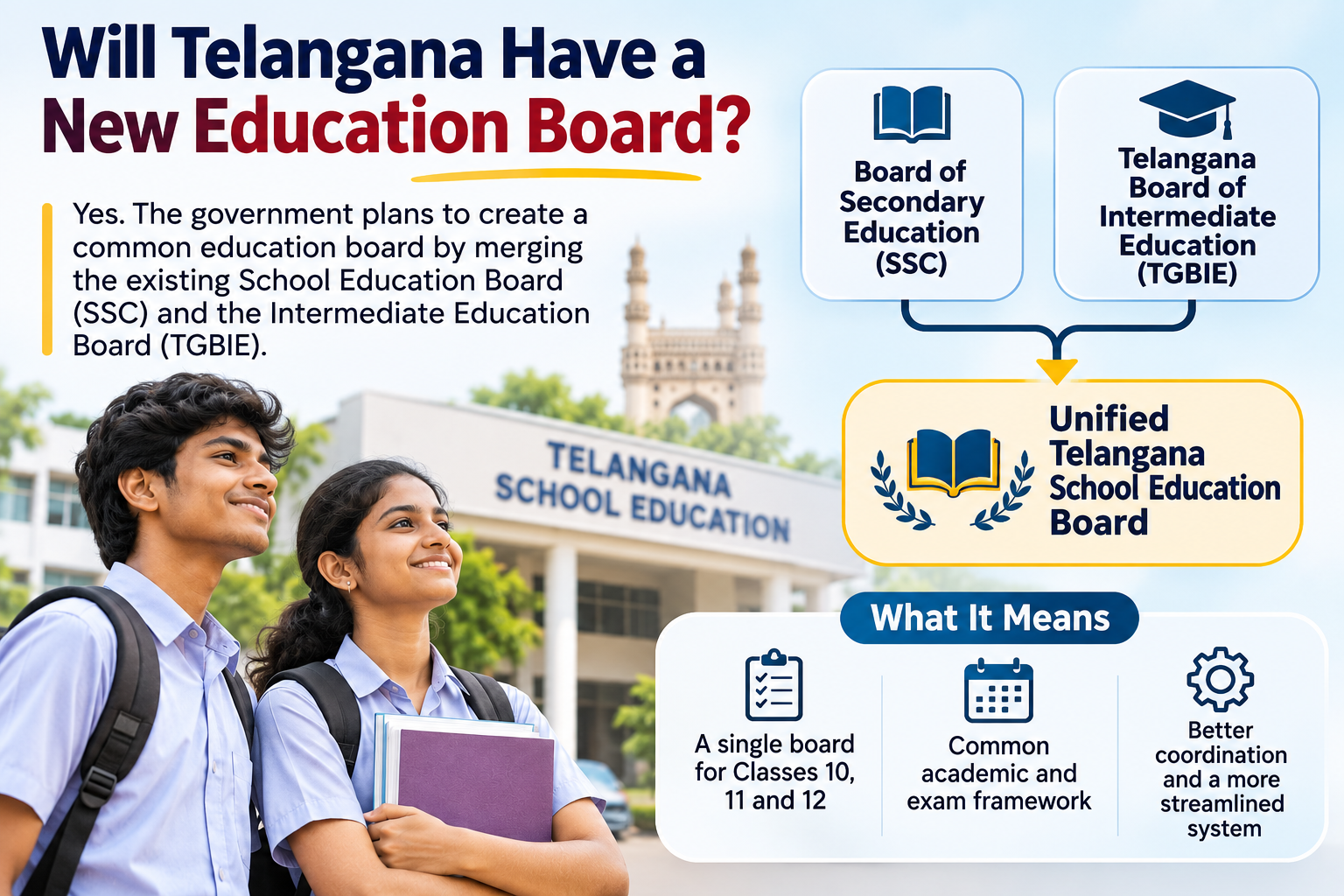
Yes. The government is planning to establish a common education board by integrating the existing school and Intermediate education boards.
Currently, the Board of Secondary Education manages SSC examinations, while the Telangana Board of Intermediate Education (TGBIE) oversees Intermediate courses, examinations and junior college administration.
Under the proposed arrangement, both boards are expected to come under a unified structure, which may be called the Telangana School Education Board.
The proposed board will manage academic activities, institutional recognition and examinations for the relevant classes.
Reports also indicate that the government is considering a separate examination wing for Class 10 and another for Classes 11 and 12.
To implement the merger, the government is expected to amend the existing education laws and introduce new legislation.
When Will the New System Be Implemented?
The government is planning a phased implementation rather than introducing all changes at once.
The following timeline has been reported:
2026-27: Consultations, policy preparation and administrative planning.
2027-28: Proposed introduction of the integrated senior secondary education structure.
2028-29 and 2029-30: Further expansion and upgrading of existing junior colleges and schools.
The government is also considering introducing the necessary legal changes through a Bill during the upcoming winter Assembly session.
The complete transition is expected to take place gradually, with existing institutions receiving time to develop the required infrastructure.
What Will Happen to Existing Junior Colleges?
One of the major questions surrounding the proposed reform concerns the future of government and private junior colleges.
Under the proposed arrangement, existing junior colleges may gradually be converted into integrated schools offering education up to Class 12.
Telangana has around 430 government junior colleges under the School Education Department, which are expected to be part of the restructuring process.
Reports suggest that 96 government junior colleges may be upgraded as Telangana Public Schools in the first phase during 2027-28.
Other institutions may follow a phased or twin-campus model during the subsequent academic years.
Private junior colleges and school managements are also expected to receive opportunities to expand their institutions by adding different classes, subject to the government's proposed guidelines.
Will the Intermediate Syllabus and Examinations Change?
At present, there is no confirmed announcement about an immediate change in the Intermediate syllabus.
According to education department officials, the existing syllabus for Classes 11 and 12 is expected to continue during the transition unless the government announces further changes.
Another important proposal under discussion is discontinuing the separate public examination for Intermediate First Year (Class 11), following a pattern similar to the CBSE system.
However, the final examination structure has not yet been officially established.
Students should therefore continue preparing according to the existing academic and examination guidelines until the government releases detailed instructions.
How Will the Merger Affect Students and Parents?
The proposed merger could bring several changes to students' academic journeys.
1. Continuous Education After Class 10
Students may be able to continue their education in the same institution after completing Class 10, reducing the difficulties associated with changing schools and colleges.
2. Better Access to Higher Secondary Education
Schools in areas where separate junior colleges are limited may gradually introduce Classes 11 and 12, potentially improving access to senior secondary education.
3. Reduced Dropout Rates
The government expects that a continuous education system will encourage more students to continue studying after Class 10, particularly girls and students from disadvantaged communities.
4. Changes in Examination Patterns
If the proposed examination reforms are introduced, students may experience changes in the way their academic performance is assessed in Classes 11 and 12.
5. More Integrated Academic Support
Students may receive academic guidance and support throughout their school education, instead of experiencing a major institutional transition after Class 10.
What Are the Major Concerns Regarding the Merger?
Although the proposal aims to improve educational access, its implementation will require careful planning.
One major concern is infrastructure. Many existing schools may not have sufficient classrooms, science laboratories, libraries and other facilities required for senior secondary education.
Another important issue is the availability of qualified teachers. Classes 11 and 12 require subject-specialist teachers, particularly in Physics, Chemistry, Mathematics, Biology and other specialised subjects.
Teachers and junior college managements have also raised questions about staff appointments, service conditions and the future of existing institutions.
There are also concerns about maintaining the academic focus of Intermediate education, especially for students preparing for competitive examinations such as NEET UG and JEE Main.
The government will need to address these concerns through proper consultation, infrastructure development and clear administrative guidelines.
What Should Students Do Now?
Students currently studying in Classes 10, 11 and 12 should not make any changes to their academic plans based on the proposed merger alone.
The government has indicated that the transition will take place in phases. Students should continue following the existing syllabus, examination schedules and admission procedures until official notifications are released.
Parents should also wait for detailed guidelines regarding school admissions, junior college upgrades, examination arrangements and the recognition of existing institutions.
Conclusion
The proposed merger of Intermediate and school education is an important development in Telangana's education sector. By bringing Classes 11 and 12 into the school education framework, the government aims to improve access to higher secondary education and reduce student dropouts after Class 10.
However, the success of this reform will depend on infrastructure, qualified teachers, examination arrangements and the protection of students' academic interests.
The coming months will be important in determining how the government finalises the policy and implements the proposed changes across the state. Students, parents, teachers and educational institutions will be closely watching the developments
If you wish to obtain an education loan or would like information about it, please click on the link below.
https://bodmaseducation.com/education-loan
Powered by Froala Editor