

 Download App


The National Medical Commission (NMC) has proposed an important change to the Foreign Medical Graduate (FMG) licensing regulations through a draft amendment published in the Gazette of India on November 17, 2026.
The proposed amendment seeks to modify Clause 4(b) of the National Medical Commission (Foreign Medical Graduate Licentiate) Regulations, 2021. This particular clause deals with the registration and licensing requirements that Indian students must fulfil in the country where they obtain their foreign medical degree.
The proposed change may provide some relief to foreign medical graduates who face difficulties in obtaining a full medical practice licence in the country where they studied. However, the amendment is still at the draft stage and should not be treated as an implemented rule.
What Did the NMC Say in the 2021 FMG Regulations?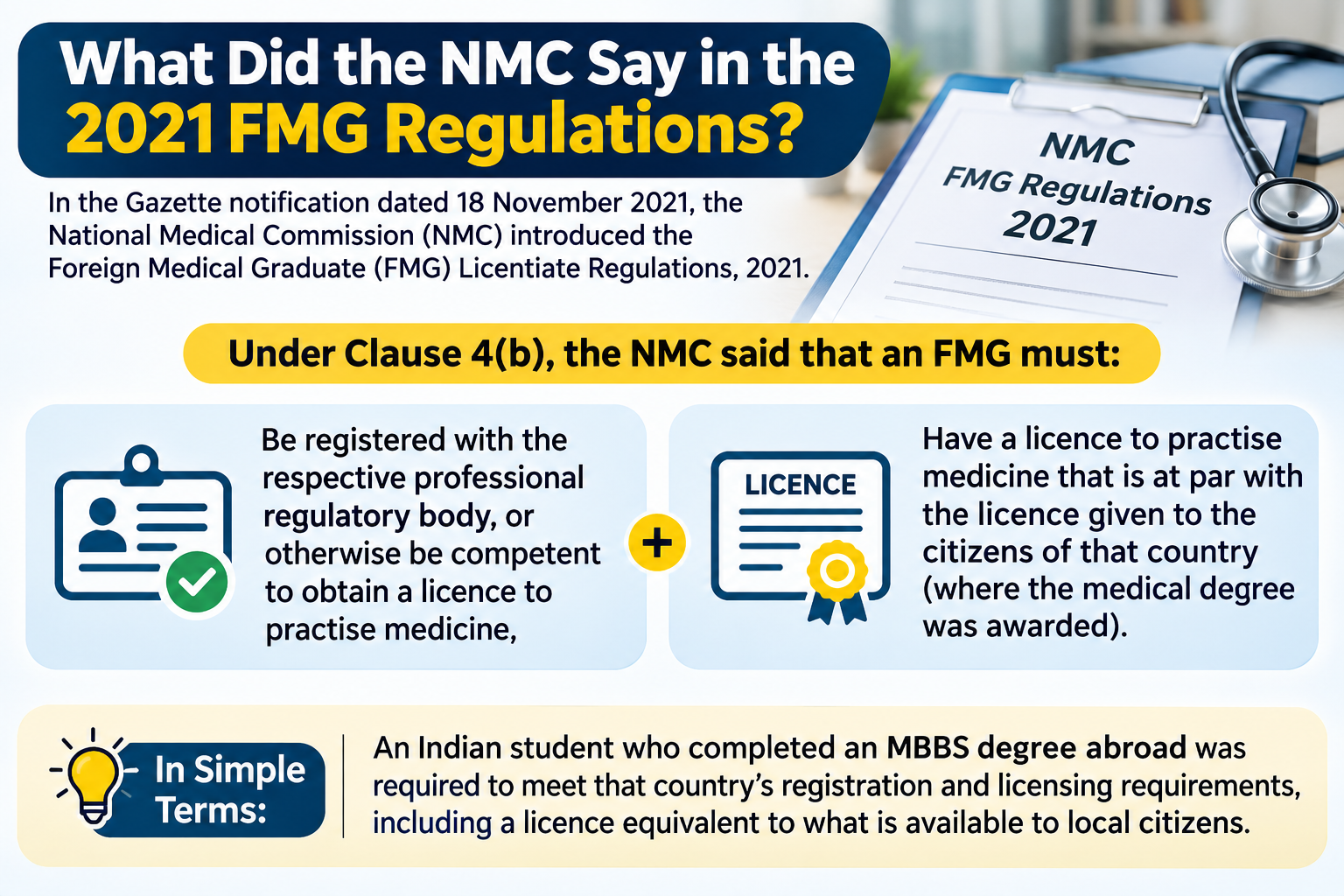
On November 18, 2021, the National Medical Commission introduced the Foreign Medical Graduate Licentiate Regulations, 2021.
Under Clause 4(b), an FMG was required to fulfil a specific condition related to registration or licensing in the country where the medical degree was awarded.
The original provision stated that the foreign medical graduate must:
Be registered with the respective professional regulatory body or otherwise be competent to obtain a licence to practise medicine in the jurisdiction of the country where the medical degree was awarded.
Have a licence to practise medicine that was at par with the licence given to citizens of that country.
In simple terms, the regulation required an Indian student who completed an MBBS degree abroad to meet the relevant professional registration or licensing requirements of that country. The licence or practice eligibility also had to be equivalent to what was available to the citizens of that country.
This condition became an important consideration for Indian students studying medicine in different foreign countries because medical registration and licensing systems are not the same everywhere.
In some countries, obtaining a full licence to practise independently may involve additional examinations, training or other requirements. Consequently, students could face difficulties in meeting the Indian regulatory condition, depending on the licensing framework of the country where they studied.
What Has NMC Proposed in the 2026 Draft Amendment?
In the draft amendment dated November 17, 2026, the NMC has proposed replacing the existing wording of Clause 4(b).
The proposed revised provision states:
"registered with the respective professional regulatory body in that country".
This is a shorter and comparatively simplified provision.
The most important difference is that the proposed amendment removes the specific reference to:
Being otherwise competent to obtain a licence to practise medicine in that country's jurisdiction.
Having a licence equivalent to the licence provided to citizens of that country.
Instead, the proposed provision focuses on registration with the respective professional regulatory body in the country where the medical degree was awarded.
This means that the explicit requirement of having a practice licence at par with that country's citizens would no longer appear in Clause 4(b), if the proposed amendment is finalised in its present form.
2021 vs 2026: What Is the Difference?
The following table explains the difference between the existing regulation and the proposed amendment.
Particulars
2021 Regulations
2026 Draft Amendment
Country-related requirement
Registration or other competence to obtain a licence
Registration with the respective professional regulatory body
Local practice licence
Reference to eligibility for a licence to practise medicine
No separate reference to obtaining a local practice licence
Comparison with local citizens
Licence must be at par with that given to citizens
This explicit comparison is removed
Regulatory focus
Registration/licensing eligibility and equivalence
Registration with the professional regulatory body
Legal status
Existing notified regulation
Proposed draft amendment
The proposed amendment is specifically limited to Clause 4(b) of the 2021 regulations. It does not replace the entire FMG licensing framework.
Why Is This Proposed Amendment Important for Indian Students Studying MBBS Abroad?
Indian students pursue medical education in several countries, including Russia, Ukraine, Kazakhstan, Georgia, Kyrgyzstan, Uzbekistan, Bangladesh, Nepal and other destinations.
However, every country has its own medical education and professional licensing system.
In some countries, registration with a professional regulatory authority and obtaining a full licence for independent medical practice may be two different stages. A graduate may need to complete additional local requirements before receiving the same practice rights as a citizen.
The 2021 provision specifically referred to a licence equivalent to the one given to citizens. This could create difficulties for foreign graduates in countries where the licensing process for international students differs from the pathway followed by local medical graduates.
The 2026 draft proposes removing this explicit equivalence requirement and retaining registration with the respective professional regulatory body.
If finalised, this change could make the country-specific registration requirement less restrictive for certain categories of foreign medical graduates.
However, the actual benefit will depend on how the respective country's professional regulatory system works and how the NMC implements the amended provision.
Which FMG Requirements Will Remain Unchanged?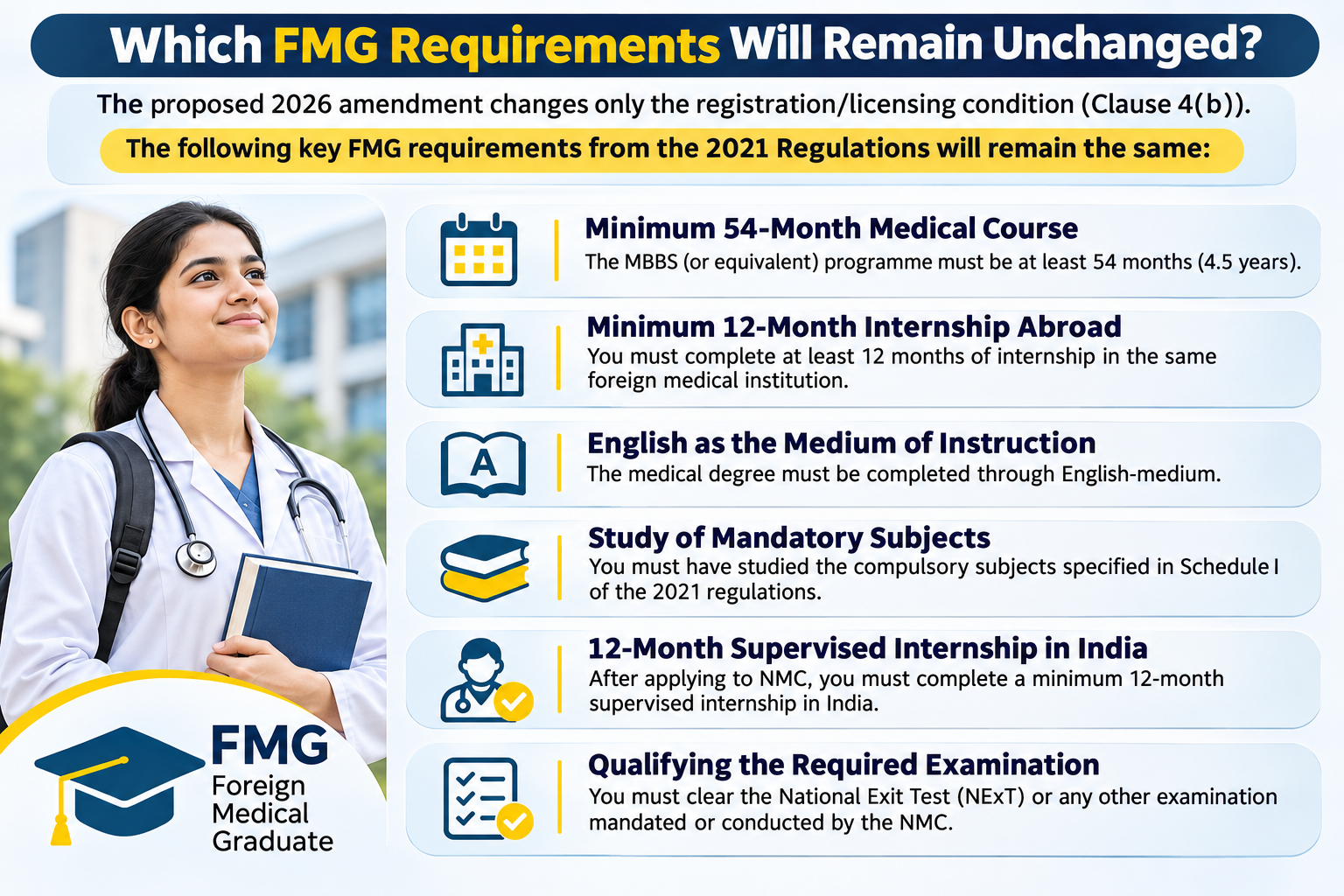
An important point for students and parents is that the proposed amendment does not remove the other requirements under the 2021 FMG Regulations.
The NMC has proposed changing only Clause 4(b). The remaining provisions of Clause 4 have not been amended in this draft.
The following requirements therefore remain part of the existing regulatory framework
1. Minimum 54-Month Medical Course
The foreign medical graduate must have completed a medical degree course with a minimum duration of 54 months.
2. Minimum 12-Month Internship Abroad
The student must complete an internship of at least 12 months in the same foreign medical institution.
3. English as the Medium of Instruction
The foreign medical degree must be obtained through a course where the medium of instruction is English.
4. Mandatory Medical Subjects
The student must have studied the mandatory subjects mentioned in Schedule I of the 2021 regulations.
5. 12-Month Supervised Internship in India
After applying to the Commission, the foreign medical graduate must complete a minimum 12-month supervised internship in India.
6. Qualifying the Required Examination
The candidate must clear the National Exit Test (NExT) or another examination mandated or conducted by the Commission.
Therefore, the proposed change should not be interpreted as an exemption from India's other FMG eligibility and licensing requirements.
Is the 2026 Amendment Finalised?
No. The November 17, 2026 Gazette notification is a draft amendment.
The NMC has invited objections and suggestions from individuals and organisations who may be affected by the proposed changes.
According to the draft notification:
The proposed amendment will be considered after the expiry of 30 days from the date on which the Gazette copies are made publicly available.
Stakeholders can submit their objections and suggestions to the NMC.
Submissions must be sent to the designated email address: ug.fmgl.amend2026@nmc.org.in.
The NMC will consider the objections and suggestions received within the specified period.
The draft also states that the amendment will come into force on the date of its publication in the Official Gazette. This provision will apply when the amendment is formally finalised and notified, not merely because the draft has been published.
Students should therefore wait for the final notification before making decisions based on the proposed change.
What Should FMG Students and Parents Understand?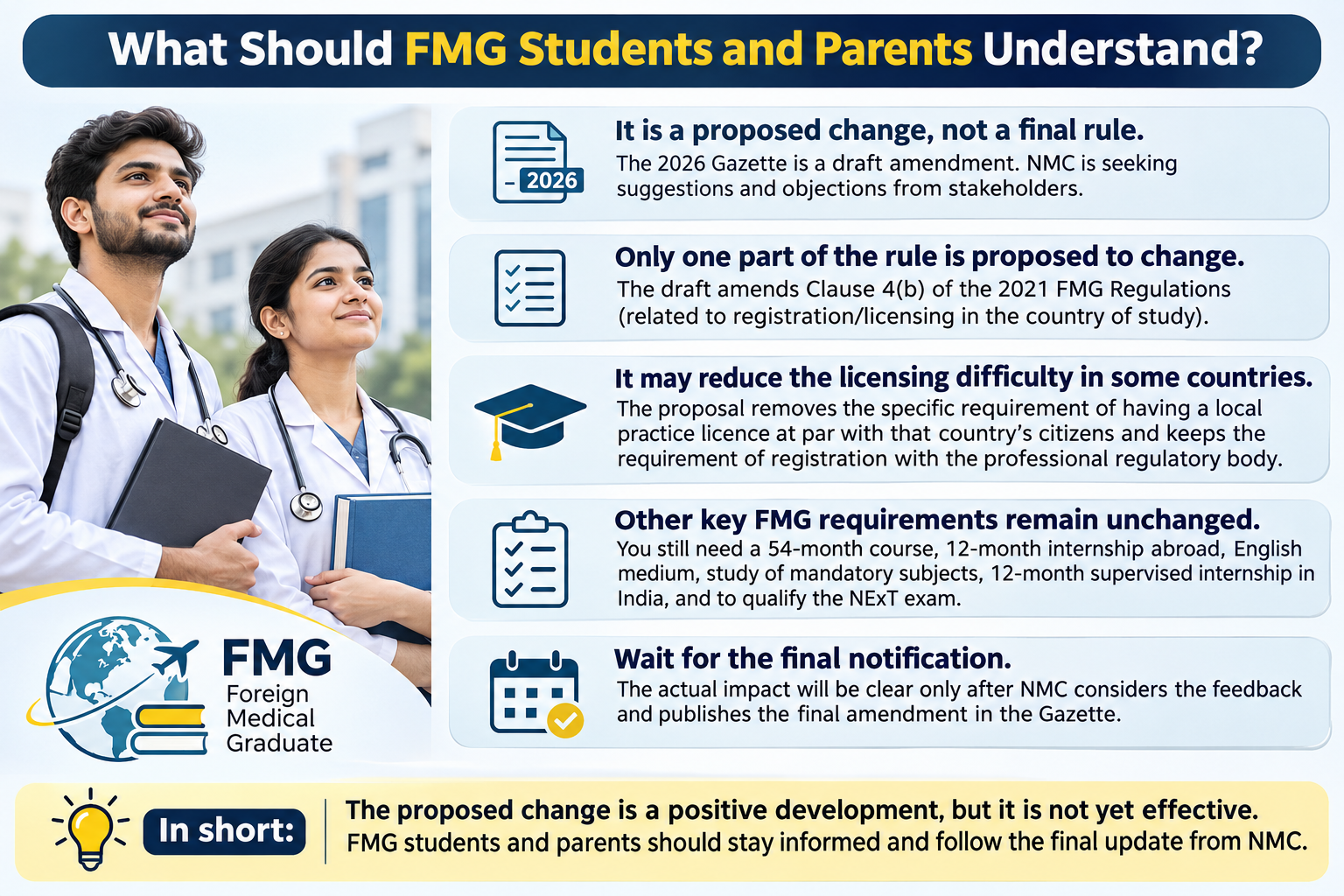
The proposed amendment is an important development in the regulation of foreign medical graduates in India.
The 2021 regulations specifically linked registration and licensing eligibility in the country of medical education with the licence available to that country's citizens. The 2026 draft proposes removing this explicit comparison and retaining the requirement of registration with the respective professional regulatory body.
This may address some of the difficulties arising from differences in medical licensing systems across countries.
However, it is equally important to understand that the proposal does not automatically grant Indian FMGs the right to practise medicine in India. The other requirements under the 2021 regulations, including the Indian supervised internship and the prescribed qualifying examination, remain relevant.
The final position will become clear only after the NMC considers the suggestions and publishes the final amendment, if approved.
For students planning to study MBBS abroad, the recognition of the medical institution, the course structure, internship arrangements and professional registration requirements in the country of study should continue to be carefully examined before taking admission.
Conclusion
The proposed 2026 amendment represents a targeted change in the NMC's approach to foreign medical graduate registration requirements.
Rather than requiring an explicit comparison between the licence available to foreign graduates and the licence given to local citizens, the draft focuses on registration with the professional regulatory body in the country where the medical degree is awarded.
Whether this change will resolve the practical difficulties faced by Indian medical graduates in different countries will depend on the final regulations and their implementation.
For now, students and parents should treat this development as a proposed regulatory change rather than a final relaxation of FMG licensing requirements.
Powered by Froala Editor