

 Download App



Indian medical graduates from recognised medical institutions in the Philippines can now appear for the country's Physician Licensure Examination (PLE). The decision provides important clarity for Indian students pursuing medical education in the Philippines and addresses a key condition under India's foreign medical graduate regulations.
The development was confirmed by Indian Ambassador to the Philippines, Harsh Kumar Jain. According to the announcement, the Philippine Professional Regulation Commission (PRC) has communicated its decision to allow eligible Indian medical graduates to appear for the licensing examination.
This development is particularly important because the National Medical Commission (NMC) has prescribed certain conditions for Indian students who obtain their medical degrees from foreign countries and wish to practise medicine in India.
What Is the Latest Decision by the Philippines?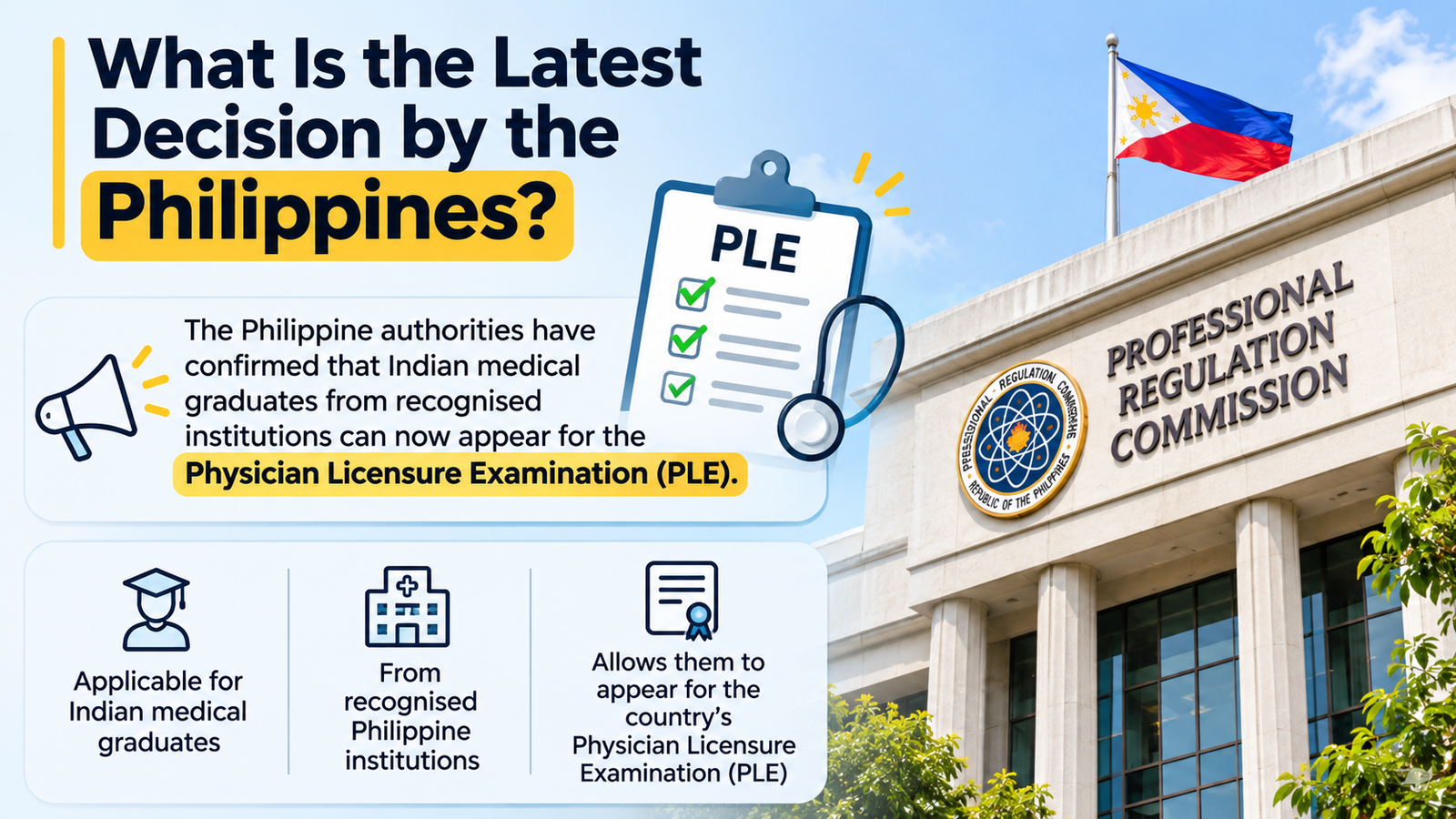
The Philippine authorities have clarified that Indian medical graduates from recognised institutions can appear for the country's Physician Licensure Examination.
The PLE is a professional licensing examination required for medical graduates who want to obtain registration and practise medicine in the Philippines.
Earlier, the eligibility of Indian graduates to appear for this examination was an important concern because Philippine regulations included a reciprocity condition for foreign applicants. Under this condition, foreign medical graduates could face restrictions on appearing for professional licensing examinations unless their home country provided similar professional practice rights to Philippine citizens.
The latest decision addresses this concern for Indian medical graduates and provides a clearer licensing pathway after completing their medical education in recognised institutions in the Philippines.
Why Is This Decision Important for Indian FMG Students?
The decision is significant because it addresses one of the important requirements under the National Medical Commission's Foreign Medical Graduate Licentiate (FMGL) Regulations, 2021.
Under the applicable regulations, Indian students pursuing medical education abroad must fulfil specific academic, clinical training, internship and registration-related requirements.
One of the important conditions concerns the graduate's eligibility to obtain a licence or registration to practise medicine in the country where the medical qualification is awarded.
The earlier uncertainty regarding Indian graduates appearing for the Philippine PLE created questions about whether students completing their medical education in the country would satisfy this particular requirement.
With the latest clarification, an important regulatory concern has been addressed. However, students must still fulfil all other conditions prescribed by the NMC.
What Were the Earlier NMC Requirements for Medical Education in the Philippines?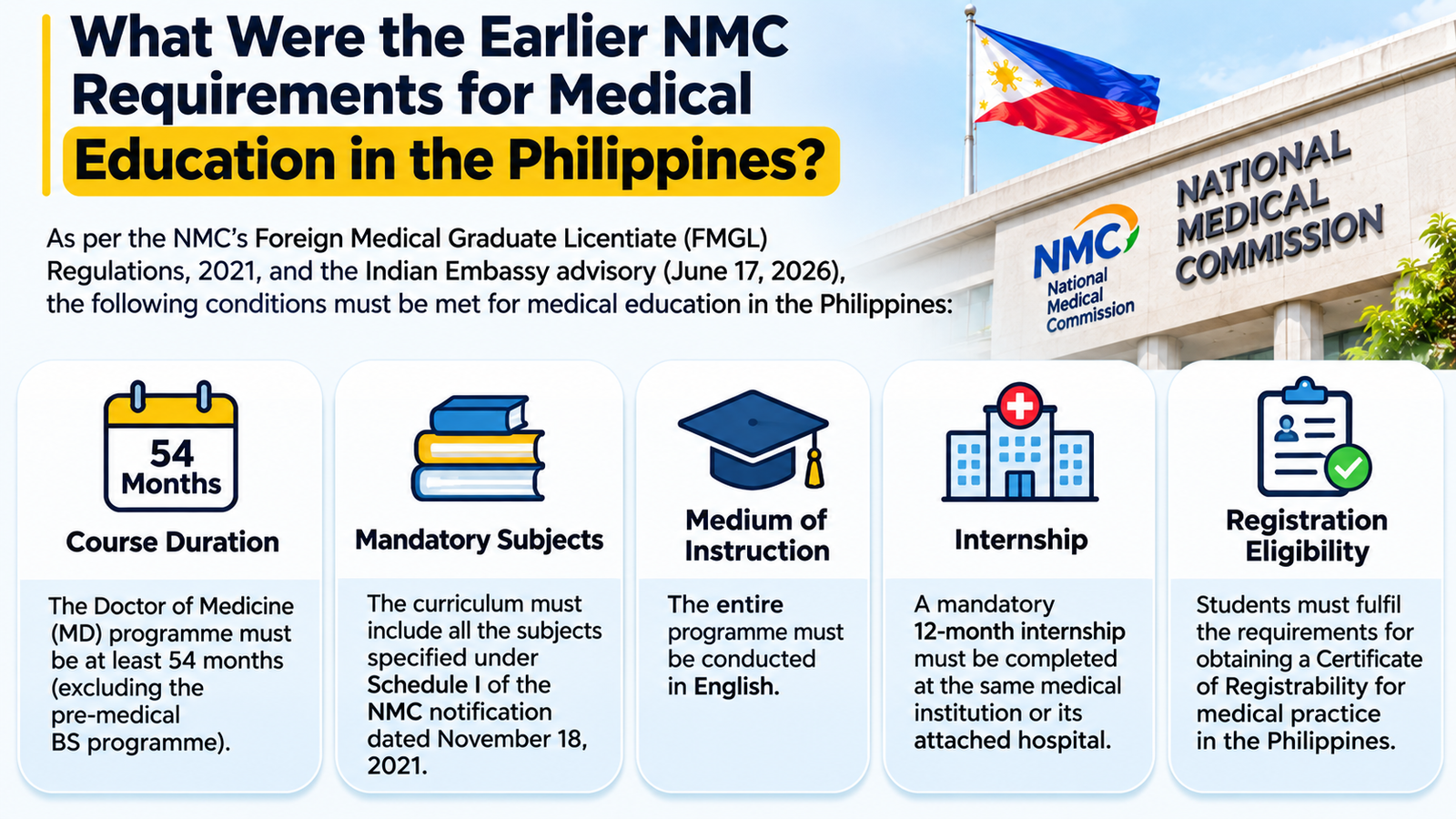
The Indian Embassy in Manila issued an advisory on June 17, 2026, explaining the regulatory position regarding medical education in the Philippines.
The advisory referred to a clarification provided by the Philippines' Commission on Higher Education (CHED) on May 8, 2025.
According to the clarification, the Doctor of Medicine (MD) programme offered by recognised higher education institutions in the Philippines meets several requirements under India's FMGL Regulations.
These include:
Course Duration: The Doctor of Medicine programme must have a duration of 54 months, excluding the pre-medical Bachelor of Science (BS) programme.
Mandatory Subjects: Students must study the subjects specified under Schedule I of the NMC notification dated November 18, 2021.
Medium of Instruction: The programme must be conducted entirely in English.
Internship: Students must complete a mandatory 12-month internship at the same medical institution or its attached hospital.
Registration Eligibility: Students must fulfil the requirements relating to obtaining a Certificate of Registrability for medical practice in the Philippines.
The Embassy's June 2026 advisory also referred to Resolution No. 73, adopted by the Philippine House of Representatives on March 11, 2026, which endorsed the compliance of the country's recognised MD programmes with the relevant NMC requirements.
However, the Embassy had also highlighted the need for clarity regarding the eligibility of Indian graduates to appear for the Philippine licensing examination. The latest decision addresses this particular concern.
Does Passing the Philippine PLE Automatically Allow Students to Practise in India?
No. Appearing for or passing the Philippine Physician Licensure Examination does not automatically provide Indian medical graduates with permission to practise medicine in India.
Students who complete their medical education abroad and intend to return to India must continue to comply with the applicable NMC regulations.
Indian nationals and Overseas Citizens of India (OCI) candidates with foreign medical qualifications are required to qualify the Foreign Medical Graduate Examination (FMGE), conducted by the National Board of Examinations in Medical Sciences (NBEMS), under the applicable regulatory framework.
FMGE qualification is necessary for obtaining provisional or permanent registration from the NMC or the respective State Medical Council.
Students must also ensure that their medical qualification, course duration, clinical training and internship meet the prescribed requirements.
Therefore, the latest decision by the Philippines should be understood as an important clarification concerning eligibility for its licensing examination, rather than a relaxation of India's medical licensing requirements.
How Many Indian Students Could Be Affected by This Decision?
According to reports, more than 7,000 Indian students are pursuing higher education in the Philippines. Medical education is one of the important areas of interest among Indian students choosing the country for overseas studies.
The latest decision may provide greater clarity to students who are already studying medicine in the Philippines, particularly those who plan to return to India after completing their degrees.
It may also help parents and prospective students understand the professional licensing pathway before selecting a medical institution abroad.
However, the recognition and regulatory compliance of individual institutions and programmes remain important considerations.
What Should Indian Students Planning to Study MBBS in the Philippines Understand?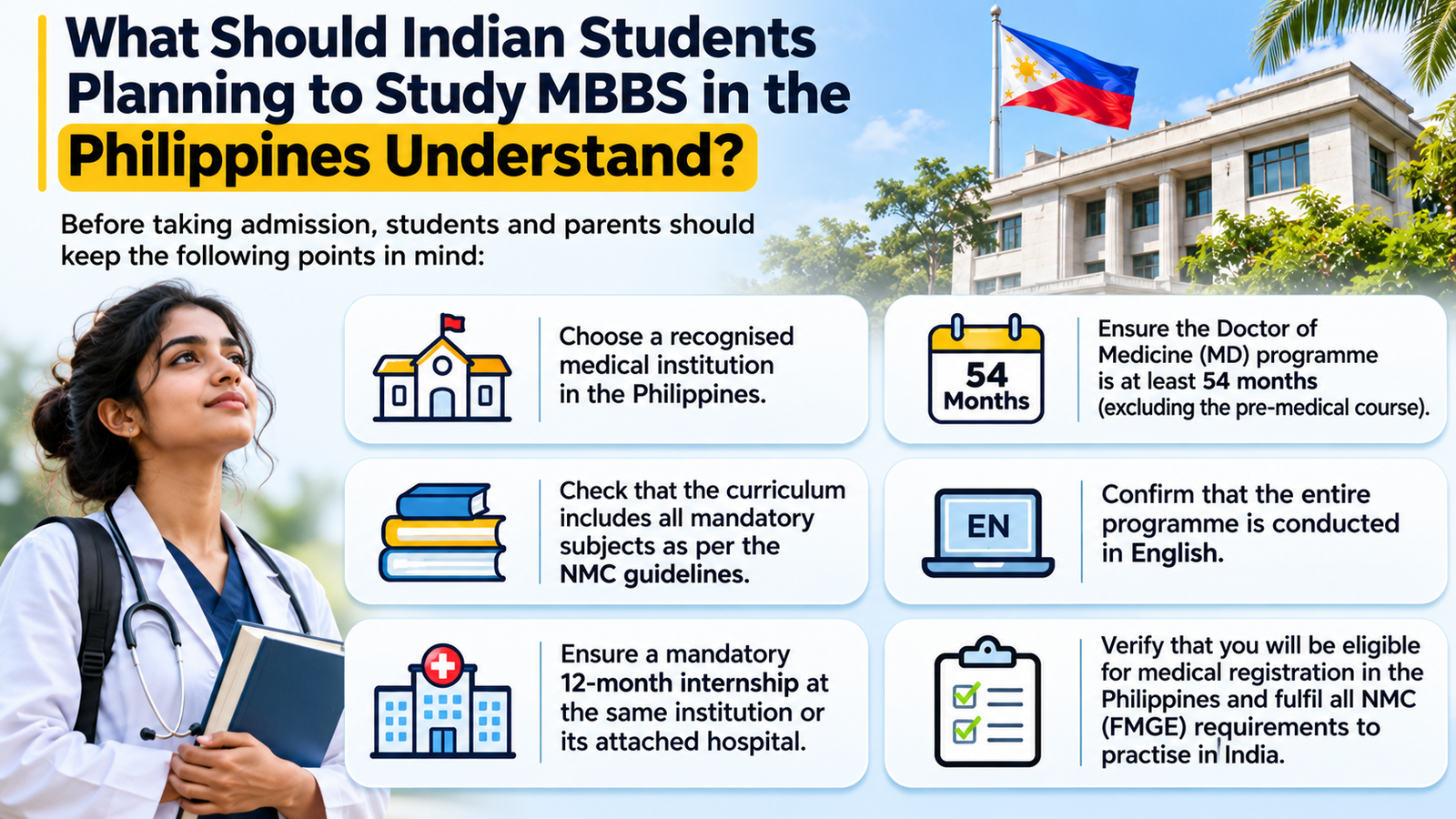
Students planning to pursue medical education in the Philippines should not make admission decisions based only on the latest announcement.
Before taking admission, students and parents should carefully verify the following:
Whether the medical institution is recognised by the competent authorities in the Philippines.
Whether the Doctor of Medicine programme fulfils the duration requirements prescribed by the NMC.
Whether the course includes all mandatory subjects and clinical training.
Whether the student can complete the required 12-month internship at the same institution or its attached hospital.
Whether the qualification meets the applicable requirements for medical registration in the Philippines.
Whether the student will fulfil the FMGE and other applicable requirements for registration in India.
The latest decision addresses an important concern regarding medical registration in the Philippines. However, students should verify all applicable regulatory conditions before enrolling in a foreign medical programme.
Conclusion
The Philippines' decision to allow eligible Indian medical graduates from recognised institutions to appear for the Physician Licensure Examination is an important development for Indian students pursuing medical education in the country.
It addresses a significant concern related to reciprocal medical registration and one of the conditions under India's foreign medical graduate regulations.
However, the decision does not remove the requirement to fulfil NMC regulations for practising medicine in India. Students returning to India must continue to meet the applicable qualification, internship and licensing examination requirements.
For students and parents, the development provides greater clarity about the professional pathway after completing medical education in the Philippines. At the same time, checking institutional recognition and regulatory compliance remains essential before making an admission decision.
Powered by Froala Editor