_1790252120.png)

 Download App

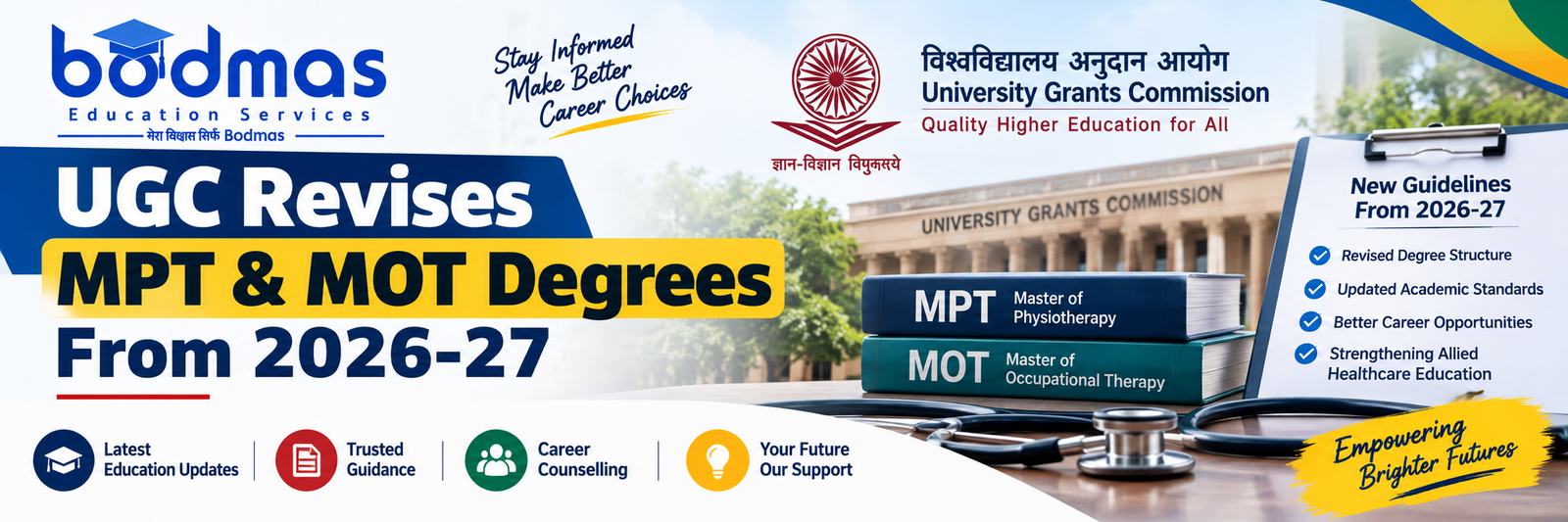
UGC Revises Allied Healthcare Degrees From 2026-27: MPT and MOT to Be Awarded With Specialisations
The University Grants Commission (UGC) has revised the nomenclature and structure of several allied and healthcare degree programmes, with the changes applying from the 2026-27 academic session. One of the key changes is that Master of Physiotherapy (M.PT) and Master of Occupational Therapy (M.OT) will no longer be awarded as general degrees. Instead, universities will award these postgraduate degrees with specified specialisations.
The changes form part of the fifth amendment to the UGC's 2014 notification on Specification of Degrees under Section 22(3) of the UGC Act, 1956. The amendment was notified in the Gazette of India on 27 August 2026, with Central Government approval.
Table of Contents
What Has Changed in MPT and MOT Degrees?
Under the revised framework, students admitted to M.PT and M.OT programmes from the 2026-27 academic session will receive degrees that identify their respective areas of specialisation.
Students who were admitted before the 2026-27 academic year will continue to be governed by the degree provisions applicable at the time of their admission.
New M.OT Specialisations Under UGC Framework
The revised degree structure specifies specialisation-based Master of Occupational Therapy (M.OT) programmes.
The listed areas include:
| S. No. | M.OT Specialisation |
|---|---|
| 1 | Musculoskeletal Sciences |
| 2 | Paediatrics and Neonatology |
| 3 | Neurosciences |
| 4 | Mental Health |
| 5 | Rehabilitation |
| 6 | Geriatrics |
| 7 | Hand and Oncological Sciences |
| 8 | Cardiovascular and Pulmonary Sciences |
| 9 | Sports Sciences |
| 10 | Paediatrics and Neonatal Sciences |
| 11 | Obstetrics and Gynaecology Sciences |
| 12 | Community Rehabilitation Sciences |
The UGC's revised framework is intended to make the area of specialisation identifiable in the degree awarded to students.
M.PT to Follow a Specialisation-Based Structure
The Master of Physiotherapy (M.PT) programme will also follow a specialised degree structure from 2026-27.
The notified areas include:
| S. No. | M.PT Specialisation |
|---|---|
| 1 | Musculoskeletal Sciences |
| 2 | Neurosciences |
| 3 | Cardiovascular and Pulmonary Sciences |
| 4 | Sports Sciences |
| 5 | Paediatrics and Neonatal Sciences |
| 6 | Obstetrics and Gynaecology Sciences |
| 7 | Oncology Sciences |
| 8 | Community Rehabilitation Sciences |
Universities offering M.PT programmes will therefore need to align their programme and degree nomenclature with the revised framework.
Why Is UGC Changing the Degree Nomenclature?
The amendment is part of a broader effort to bring greater standardisation to allied and healthcare education.
The UGC notification brings degrees falling under the regulatory framework of the National Commission for Allied and Healthcare Professions (NCAHP) within the specified degree framework. It also updates degree names and structures across multiple allied healthcare disciplines.
Other Allied Healthcare Degrees Included
The revised notification specifies a wider range of undergraduate and postgraduate degrees, including:
| Area | Examples of Degrees |
|---|---|
| Medical Laboratory Science | B.MLS, M.MLS |
| Emergency Healthcare | B.EMT |
| Paramedical Care | M.ACP |
| Anaesthesia & OT Technology | B.AOTT, M.AOTT |
| Health Information Management | B.Sc. HIM, M.Sc. HIM |
| Respiratory Technology | Master's-level specialised programmes |
| Medical Radiology & Imaging | UG and PG programmes |
| Radiation Therapy | Related allied healthcare degrees |
| Nuclear Medicine | Related healthcare programmes |
| Medical Physics | Specified degree programmes |
| Physician Associate Studies | Specified degree programmes |
| Dialysis Therapy | Specified allied healthcare programmes |
| Nutrition & Dietetics | Specified programmes |
| Psychology | Specified healthcare-related programmes |
| Medical & Psychiatric Social Work | Specified programmes |
The notification also includes programmes in areas such as medical radiology and imaging technology, radiation therapy technology, nuclear medicine technology, respiratory technology and other allied healthcare fields.
What Does This Mean for Students?
For students planning an allied healthcare career, the revised framework means that the specialisation will become more clearly reflected in the postgraduate degree nomenclature for programmes such as M.PT and M.OT.
For example, instead of receiving a degree identified simply as a general M.PT, students admitted under the new framework will study and receive the degree under one of the specified areas of specialisation.
This can make the academic pathway clearer for students when selecting a postgraduate programme, particularly where universities offer multiple specialisations.
What About Students Already Studying MPT or MOT?
The revised provisions do not retrospectively change the degree framework for students admitted before 2026-27.
According to the UGC-related notification, students admitted under the earlier regulations will continue to be covered by the provisions applicable at the time of their admission.
UGC Allied Healthcare Degree Changes: Key Points
- UGC has amended its Specification of Degrees notification.
- The amendment is the fifth amendment to the 2014 notification.
- The Gazette notification was issued on 27 August 2026.
- Changes apply to the revised allied healthcare degree framework from 2026-27.
- M.PT and M.OT will be awarded with specified specialisations rather than as general degrees.
- Several other allied healthcare UG and PG degrees have also been specified or revised.
- Students admitted before 2026-27 continue under the applicable earlier provisions.
- Universities offering these programmes will need to align their degree nomenclature and programme structure with the applicable UGC framework.
Conclusion
The latest UGC amendment brings significant changes to the structure and nomenclature of allied and healthcare degrees in India. The most notable change for postgraduate students is the move from general M.PT and M.OT degrees to specialisation-based degrees from the 2026-27 academic session.
The revised framework also formally specifies a wider range of allied healthcare degrees covering medical laboratory science, emergency medical technology, anaesthesia and operation theatre technology, radiology, respiratory technology, health information management and several other disciplines.
Students planning admission in M.PT, M.OT or other allied healthcare programmes in 2026-27 should therefore check the latest degree nomenclature and programme details of their chosen university before admission.
Need Guidance for Allied Healthcare Admissions?
Get admission guidance and stay updated with the latest healthcare and education notifications through Bodmas Education.
Powered by Froala Editor