
 Download App


India's Indian Institutes of Technology (IITs) are planning a major expansion of specialised engineering education. The Bhupat and Jyoti Mehta Family Foundation, in partnership with multiple IITs, has announced plans to create around 6,000 additional academic opportunities in Robotics, Physical Artificial Intelligence (AI), and Space Engineering and Technology over the next eight to ten years.
The first batches under this initiative are expected to begin in 2027. The proposed expansion will cover undergraduate, postgraduate and doctoral programmes. More than 120 dedicated faculty members are also expected to support teaching and research in these specialised fields.
For students preparing for JEE Main and JEE Advanced 2027, this announcement is important because it indicates that IITs are looking to expand beyond traditional engineering disciplines and introduce more specialised programmes related to future technologies.
However, students should understand that all 6,000 seats will not be available for BTech admissions or through JEE Advanced alone.
IITs 6,000 New Seats 2027: Course-Wise Distribution
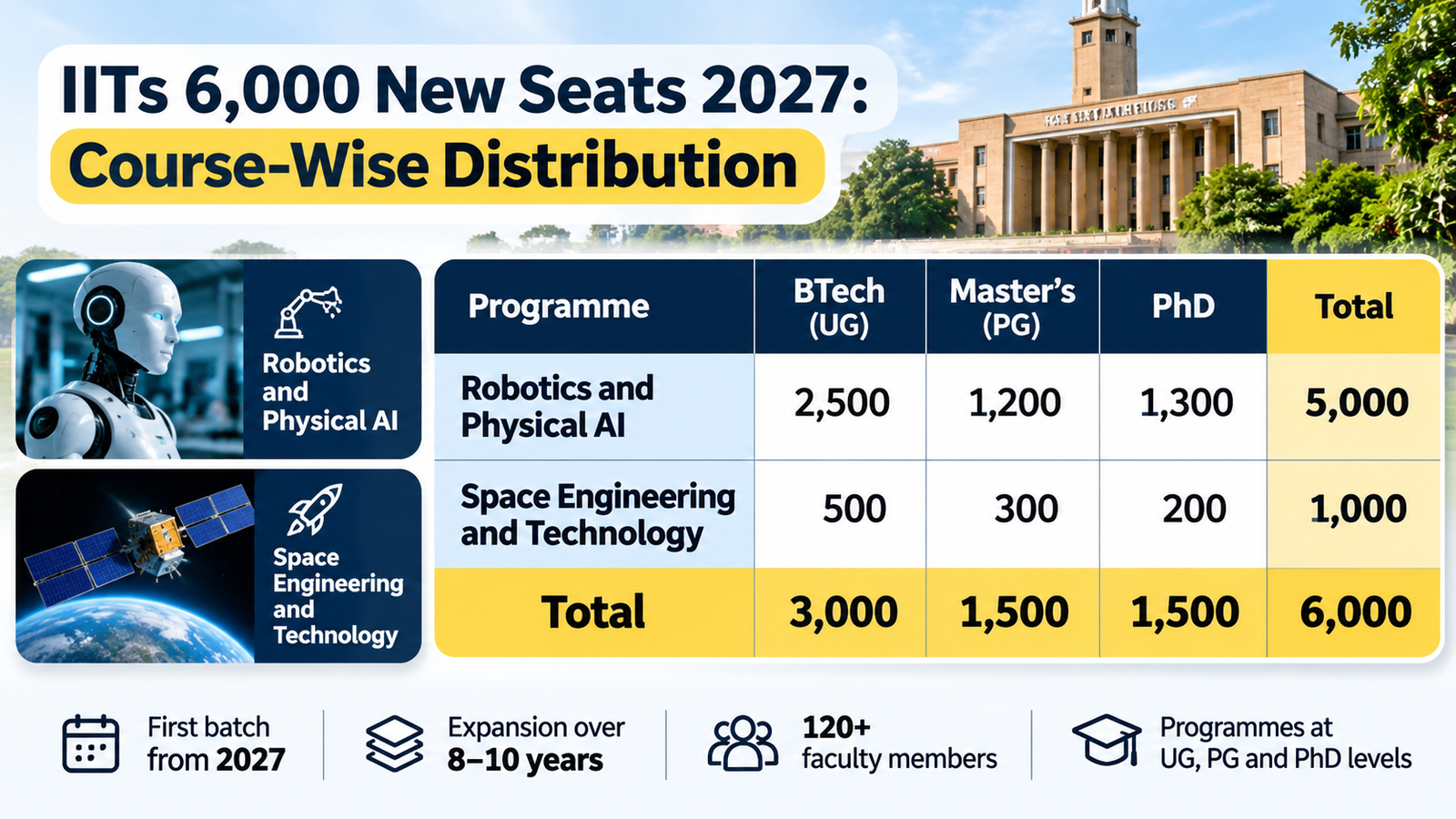
According to the announced plan, the 6,000 proposed seats will be divided into two major technology areas: Robotics and Physical AI, and Space Engineering and Technology.
The proposed distribution across different academic levels is given below.
Programme
BTech
Master's
PhD
Total
Robotics and Physical AI
2,500
1,200
1,300
5,000
Space Engineering and Technology
500
300
200
1,000
Total
3,000
1,500
1,500
6,000
The figures show that 3,000 of the proposed positions are for undergraduate BTech programmes, while the remaining 3,000 are divided equally between Master's and PhD programmes.
The expansion will take place in phases over approximately eight to ten years. Therefore, students should not expect all 6,000 seats to become available in the 2027 admission cycle.
Robotics and Physical AI: What Will Students Learn?
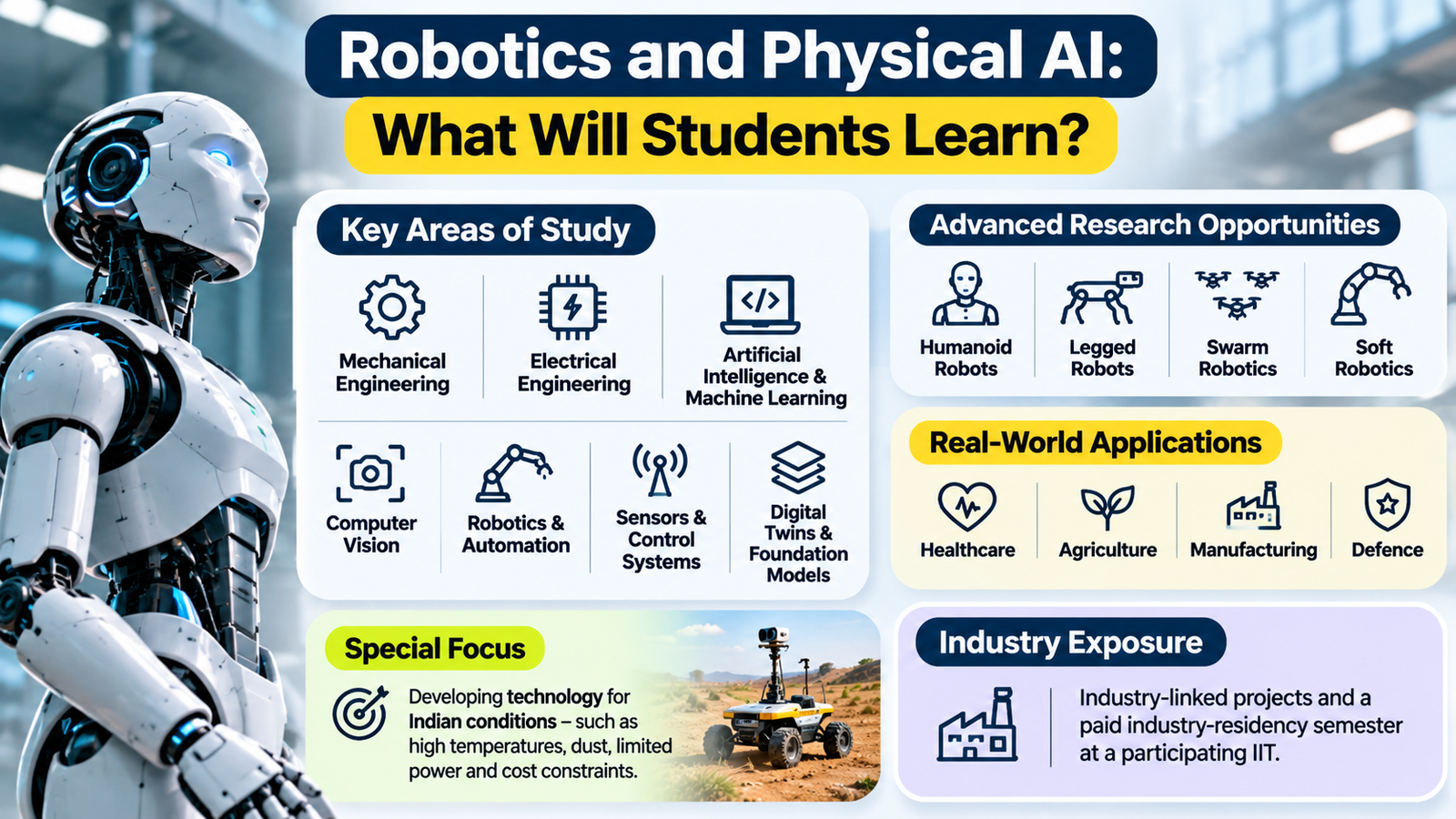
Robotics and Physical AI will receive the largest share of the proposed expansion, with 5,000 positions planned across different academic levels.
Physical AI refers to artificial intelligence systems that can interact with the physical world. Unlike traditional AI applications that mainly process text, images or digital information, Physical AI is used in machines, robots and intelligent systems that can sense their surroundings, make decisions and perform physical tasks.
The proposed programmes are expected to combine several engineering and technology subjects, including:
Mechanical Engineering
Electrical Engineering
Artificial Intelligence and Machine Learning
Computer Vision
Robotics and Automation
Sensors and Control Systems
Digital Twins and Foundation Models
Students may also get opportunities to explore advanced research areas such as humanoid robots, legged robots, swarm robotics and soft robotics.
These technologies have applications in several industries, including healthcare, agriculture, defence and manufacturing.
For example, robots can assist in manufacturing processes, perform certain healthcare-related tasks, support agricultural automation and work in environments that may be difficult or unsafe for humans.
The programmes are also expected to include industry-linked projects and a paid industry-residency semester at one participating IIT.
An important feature of the proposed curriculum is its focus on developing technology suitable for Indian conditions, including high temperatures, dust, limited power availability and cost restrictions.
Space Engineering and Technology: New Opportunities for Engineering Students
Along with Robotics and Physical AI, IITs are planning to introduce 1,000 positions in Space Engineering and Technology.
The proposed programmes will cover undergraduate, postgraduate and doctoral education.
The major areas of study are expected to include:
Satellite Navigation
Space Robotics
Human Spaceflight
Space Science and Technology
Advanced Space Engineering
A School of Space Science and Technology is also proposed at one of the participating IITs.
This initiative could provide additional academic opportunities for students interested in satellite technology, spacecraft development, space research and related engineering fields.
India's growing space sector has increased the importance of specialised technical education. Organisations working in satellite systems, launch vehicles, navigation and space research require engineers and researchers with expertise in these areas.
However, the IIT that will host the proposed School of Space Science and Technology has not yet been officially identified.
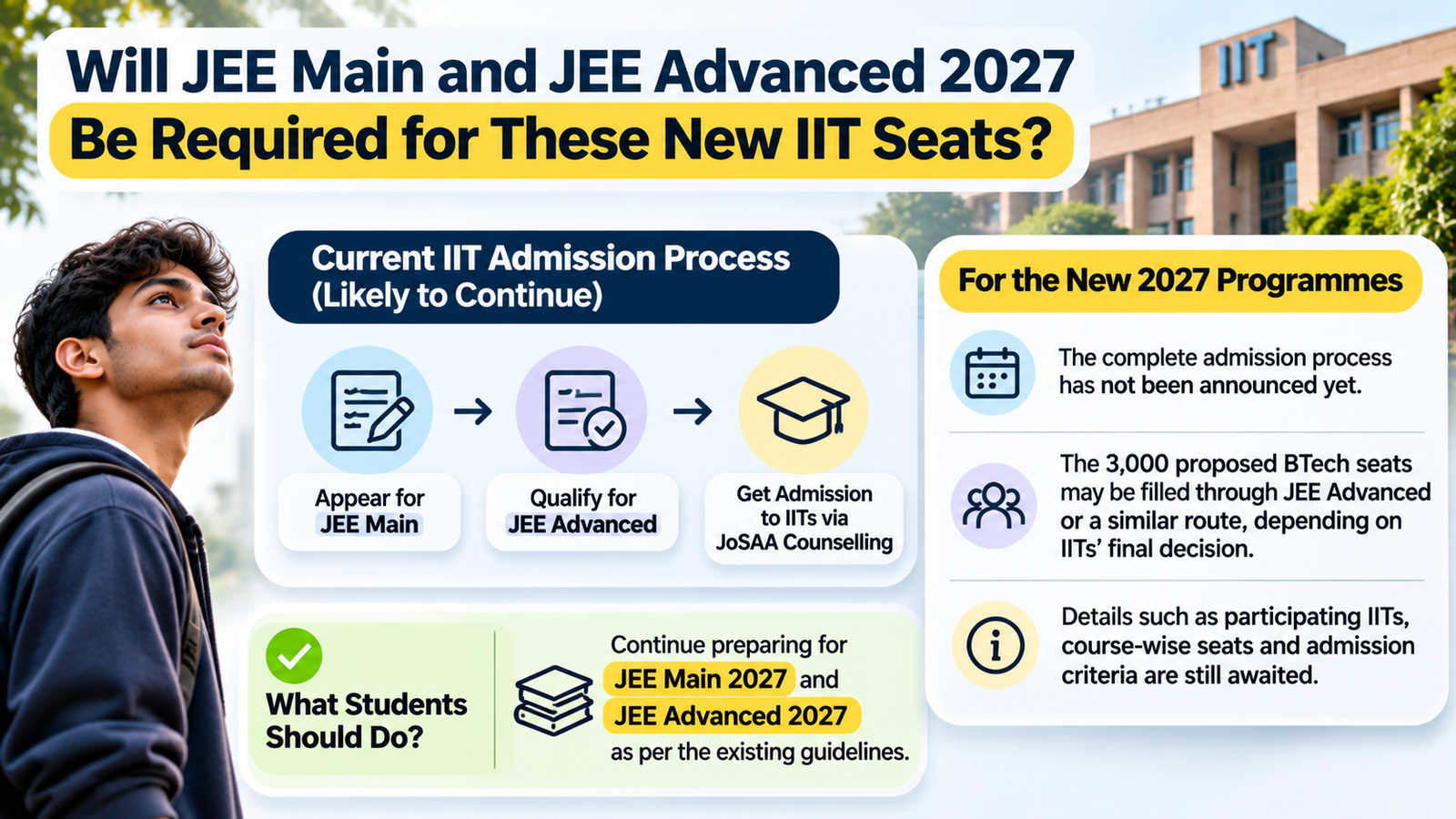
Will JEE Main and JEE Advanced 2027 Be Required for These New IIT Seats?
This is one of the most important questions for engineering aspirants.
The proposed initiative includes 3,000 undergraduate BTech positions. However, the complete admission process for these programmes has not yet been announced.
Students should not assume that all the proposed undergraduate seats will automatically be filled through JEE Advanced.
For context, the existing IIT undergraduate admission system uses JEE Advanced. Students first appear for JEE Main and must meet the eligibility requirements to qualify for JEE Advanced. Admission to IIT undergraduate programmes is then conducted through the established counselling process.
However, the admission route for the newly proposed specialised programmes will depend on the official decisions of the participating IITs.
The following details are still awaited:
Names of participating IITs
Course-wise and institute-wise seat allocation
BTech admission requirements
Whether JEE Advanced will be the admission route for all undergraduate programmes
Application dates and admission schedule
Course fees and other academic details
Students preparing for JEE Main 2027 and JEE Advanced 2027 should continue following the existing examination and admission guidelines until the IITs publish their official notifications.
Which IITs Will Offer the New Courses?
The Bhupat and Jyoti Mehta Family Foundation has been working with six IITs since 2019. Through these partnerships, the foundation has supported the establishment of eight schools and academic centres.
These centres focus on areas such as:
Data Science and Artificial Intelligence
Healthcare and Biomedical Engineering
Sustainability
According to the available announcement, these existing programmes have recorded more than 4,000 admissions across BTech, MTech and PhD courses.
The new initiative will extend this collaboration to Robotics, Physical AI and Space Engineering and Technology.
However, the names of the IITs that will introduce the new programmes have not yet been disclosed. Students will have to wait for further announcements to know which campuses will offer these courses.
JoSAA Counselling
Why Are IITs Expanding into Robotics and Artificial Intelligence?
The expansion reflects the growing importance of advanced technology in the global economy.
Robotics, automation and artificial intelligence are increasingly being used in manufacturing, healthcare, transportation, agriculture and defence.
According to the International Federation of Robotics, approximately 542,000 industrial robots were installed worldwide in 2024. This was more than twice the annual number recorded a decade earlier.
India also recorded approximately 9,100 industrial robot installations in 2024, its highest annual figure at that time.
These developments indicate a growing need for engineers who understand both software and physical machines.
Similarly, space technology is becoming an important area of scientific research and industrial development. Satellite communication, navigation, space exploration and spacecraft engineering require specialised technical knowledge.
By introducing dedicated academic programmes, IITs aim to develop a stronger talent base for these sectors.
However, the success of this initiative will depend on the quality of academic infrastructure, faculty, research facilities, industry partnerships and opportunities available to students.
IIT BTech Courses
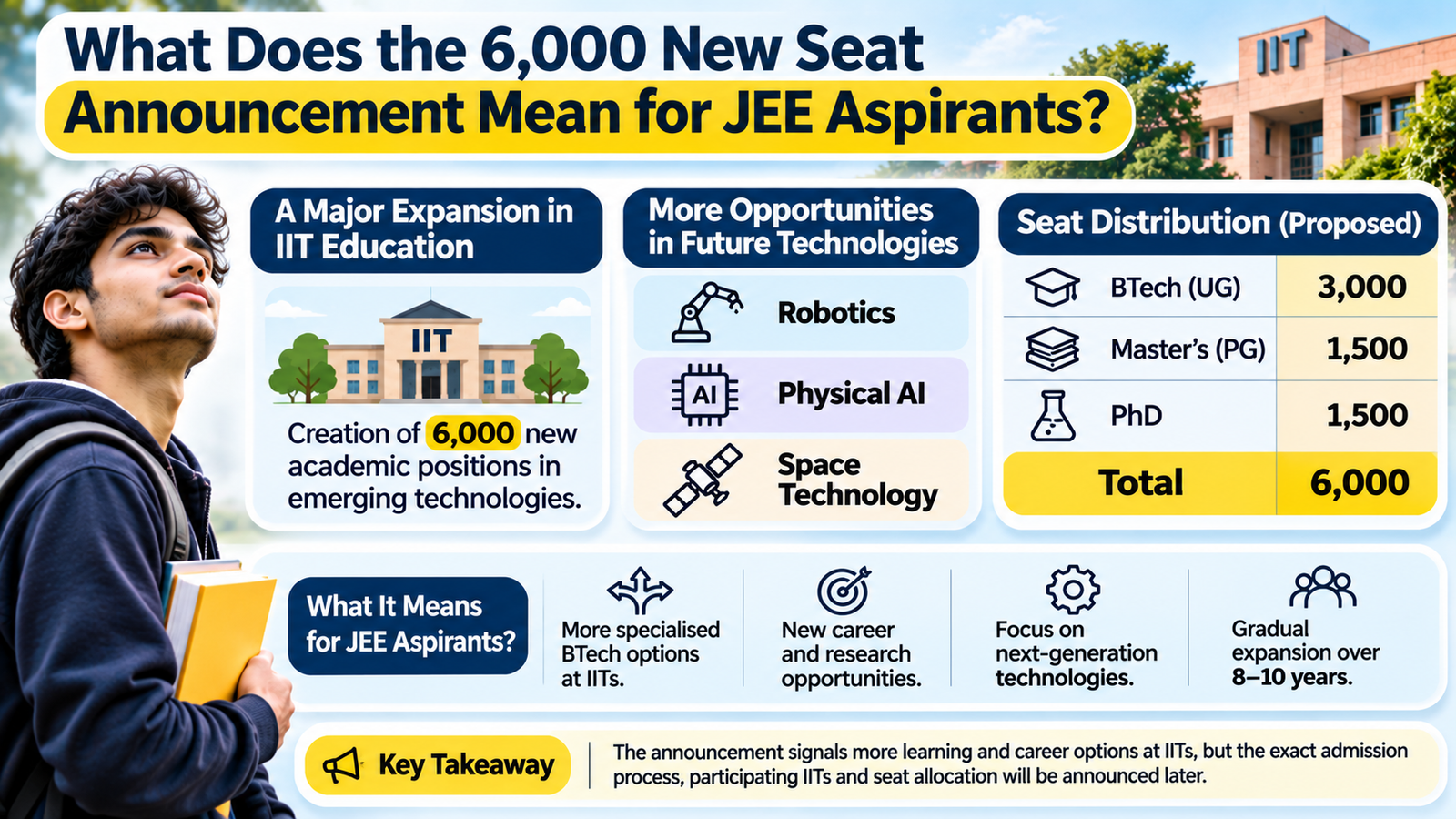
What Does the 6,000 New Seat Announcement Mean for JEE Aspirants?
For engineering aspirants, the announcement is an indication of the changing direction of technical education in India.
Traditionally, students entering IITs have chosen from established engineering disciplines such as Computer Science, Mechanical Engineering, Electrical Engineering, Civil Engineering and Chemical Engineering.
The proposed expansion could provide more specialised options for students interested in robotics, intelligent machines and space technology.
It may also create opportunities for students who want to pursue research-oriented careers rather than follow only conventional engineering career paths.
However, the announcement should not be interpreted as an immediate increase of 6,000 BTech seats in IITs. Only 3,000 positions in the proposed plan are allocated to BTech programmes, and these are expected to be introduced gradually.
The remaining 3,000 positions are for Master's and PhD programmes.
Students should also remember that the availability of new courses does not automatically guarantee placements or particular salary packages. Career opportunities will depend on students' skills, academic performance, research experience and industry demand.
IITs New Courses 2027: Important Details at a Glance
Particulars
Details
Initiative
IIT expansion in emerging technologies
Supporting organisation
Bhupat and Jyoti Mehta Family Foundation
Total proposed positions
6,000
Robotics and Physical AI
5,000
Space Engineering and Technology
1,000
Proposed BTech positions
3,000
Master's positions
1,500
PhD positions
1,500
Expected first batch
2027
Expansion period
8–10 years
Dedicated faculty
More than 120
Participating IITs
To be announced
Admission process
Awaited
Course fees
Awaited
Conclusion
The proposed addition of 6,000 positions in Robotics, Physical AI and Space Engineering and Technology marks an important development in India's technical education sector.
The initiative is expected to expand specialised education and research opportunities across undergraduate, postgraduate and doctoral levels.
For JEE Main and JEE Advanced aspirants, it could eventually offer more choices in emerging engineering disciplines. However, the actual impact on undergraduate IIT admissions will become clearer after the participating institutes announce their courses, seat allocation and admission procedures.
Students interested in these fields should keep track of official IIT admission notifications rather than make assumptions about eligibility or entrance examinations based on the initial announcement.
Powered by Froala Editor